
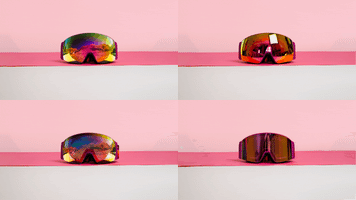
Which ski goggle lens color to choose based on snow conditions
, by Mi tienda Admin , 5 min reading time
, by Mi tienda Admin , 5 min reading time
Choosing your lens color isn't a matter of style, it's a matter of VLT and category. We'll tell you which one you need based on the day you're having on the slopes.
You get on the chairlift with your usual goggles, the dark lens you've been using for two seasons. By mid-morning, the sky clouds over, fine snow begins to fall, and suddenly you're staring at the ground as if you were driving at night without headlights. The lens isn't broken. It's just the wrong lens for the day you're having.
If you're in a hurry, here's the summary: the color of your ski goggle lens isn't a matter of aesthetics; it's a matter of how much visible light it lets through. This is measured by VLT (Visible Light Transmission) and grouped into categories, from S0 (nearly transparent) to S4 (glacier and extreme light). Choosing the wrong lens category doesn't just mean seeing a little worse; it can mean missing a bump, a patch of ice, or the skier crossing in front of you.
Most brands force you to choose a single filter for the entire season. You buy the dark lens because it "protects more" and you're practically blind on foggy days, or you buy the clear one and suffer in March when the sun is strong and the snow reflects light like a mirror.
The problem isn't your judgment in choosing a lens color, it's the product: ski goggles traditionally come with only one fixed lens. Conditions on the mountain change, but your gear stays the same all day.
VLT stands for "Visible Light Transmission": the percentage of light that passes through the lens to your eye. The lower the number, the darker the lens and the less light enters. It has no direct relationship with UV protection—that is a separate statistic, and every decent lens should block 100% of UVA and UVB rays, whether it is light or dark.
Sun filter categories (from S0 to S4) group this percentage into ranges so you don't have to memorize exact figures every time you buy a lens:

The lens category you need doesn't just depend on whether there are clouds. In the Pyrenees, fog can roll in over the north face in a matter of minutes, without warning, while the south side remains sunny. If you're wearing an S3 and fog catches you mid-run, pull over to the side of the slope until visibility improves instead of continuing to ski blindly, guided only by the sound of other skiers.
On open, high-altitude slopes (Sierra Nevada, for example, or the highest passes in the Pyrenees), the snow reflects more light than on wooded or low-altitude slopes, so on the same sunny day, you might need a darker category at the top than at the bottom.
The time of day also changes the equation. The early morning and late afternoon have much less light than midday, even if the sky is clear at all three times. If you ski the whole day, the logical thing to do isn't to tough it out with the same lens from ten to four; it's to keep the spare in your jacket's inner pocket and swap it when you notice you're straining your eyes.
From the replacement lenses by Glazzed Apparel:
This is where Sweet Avalanche cheats, in a good way: the frame is magnetic, so you can change lenses in seconds, without tools and without taking anything apart. Fog in the morning, sun at noon—the same frame works for both situations.

The pack is already designed for this: it comes with the Clear RainPow (S1) and the Cold Bake (S3), exactly the two extremes that cover most days of the season. It’s no coincidence—it’s the question we've received most from customers so far, and we solved it by including both lenses as standard instead of selling them separately.
Thinking the dark lens is "the good one" and the clear one is "the weak one." It’s exactly the opposite: wearing an S3 on a foggy day doesn't protect you more, it leaves you without visual references to calculate distances and drops. That is the real reason for many surprise falls on gray days, not the skier's lack of technique.
The second common mistake is buying by color instead of category. A pink or purple tint tells you nothing about the VLT: it could be a light lens or a dark one with a trendy tint over it. Before looking at the color of the lens, check the category number.
Summary so you don't get lost on the chairlift: overcast sky, clear lens; direct sun, dark lens; and if you don't want to carry two pairs of goggles to always be right, just change the lens. Here you have the seasonal pack with both lenses included and a case.


